



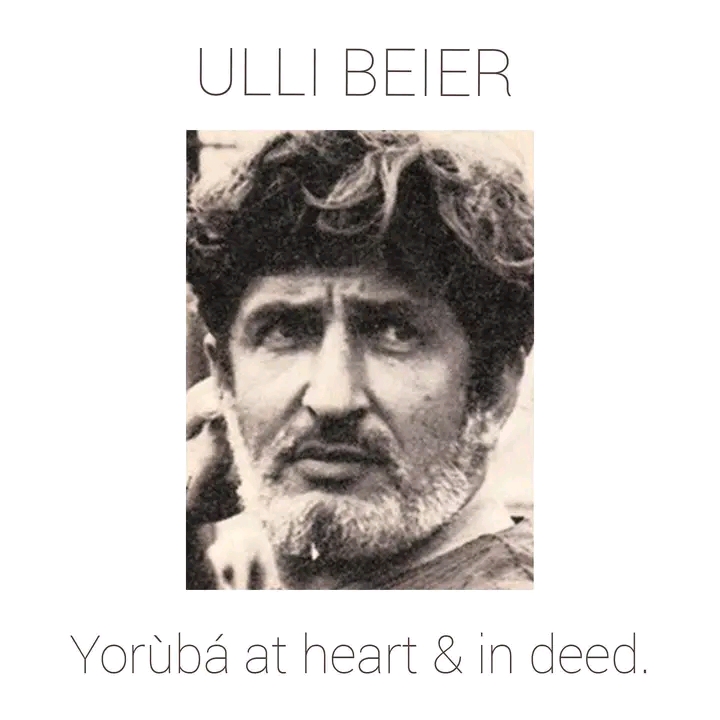
Ulli Beier: Yọrùbá Aláwọ̀ Funfun
Born in July 1922 into a Jewish middle-class family in Chotwitz (now in Poland), Ulli Beier would go on to become one of the most influential promoters of Yoruba culture and African literature.
In 1949, while teaching children with disabilities in Battersea, England, he saw an advertisement for a lecturer in English at University College Ibadan. He accepted the position and arrived in Nigeria in 1950 with his wife, the renowned Austrian artist Suzanne Wenger, who would later become a high priestess of the Osun Sacred Grove in Òṣogbo.
After living in Èdè and Ìlọ́bu, Beier settled in Òṣogbo in 1958. There, he immersed himself in Yoruba life, learning the language, participating in cultural and religious activities, collecting oral traditions, and documenting Yoruba society through photography and writing. His passion for Yoruba heritage led him to produce numerous books and articles on Yoruba history, literature, religion, and art.
In 1957, he founded Black Orpheus, a literary magazine that became one of the most important publications in Africa and the wider Black world. Through its pages, many of Africa’s greatest writers—including Wole Soyinka, Chinua Achebe, J. P. Clark, and Christopher Okigbo—reached wider audiences.
Among his notable works are Yoruba Myths, Yoruba Poetry, and Not Even God Is Ripe Enough. He also wrote under the pen name Obotunde Ijimere.
Though born far from Yorubaland, Ulli Beier devoted much of his life to preserving, promoting, and celebrating Yoruba culture, earning him a respected place in Yoruba history.
Beier spent his final years in Sydney, Australia, where he died peacefully at his home in the suburb of Annandale on 3 April 2011 at the age of 88. He was survived by his wife, Georgina Beier, and their children. Although he is remembered across Yorubaland as an adopted son of the culture, his final resting place was in Australia, far from the land whose traditions he spent decades documenting and celebrating