



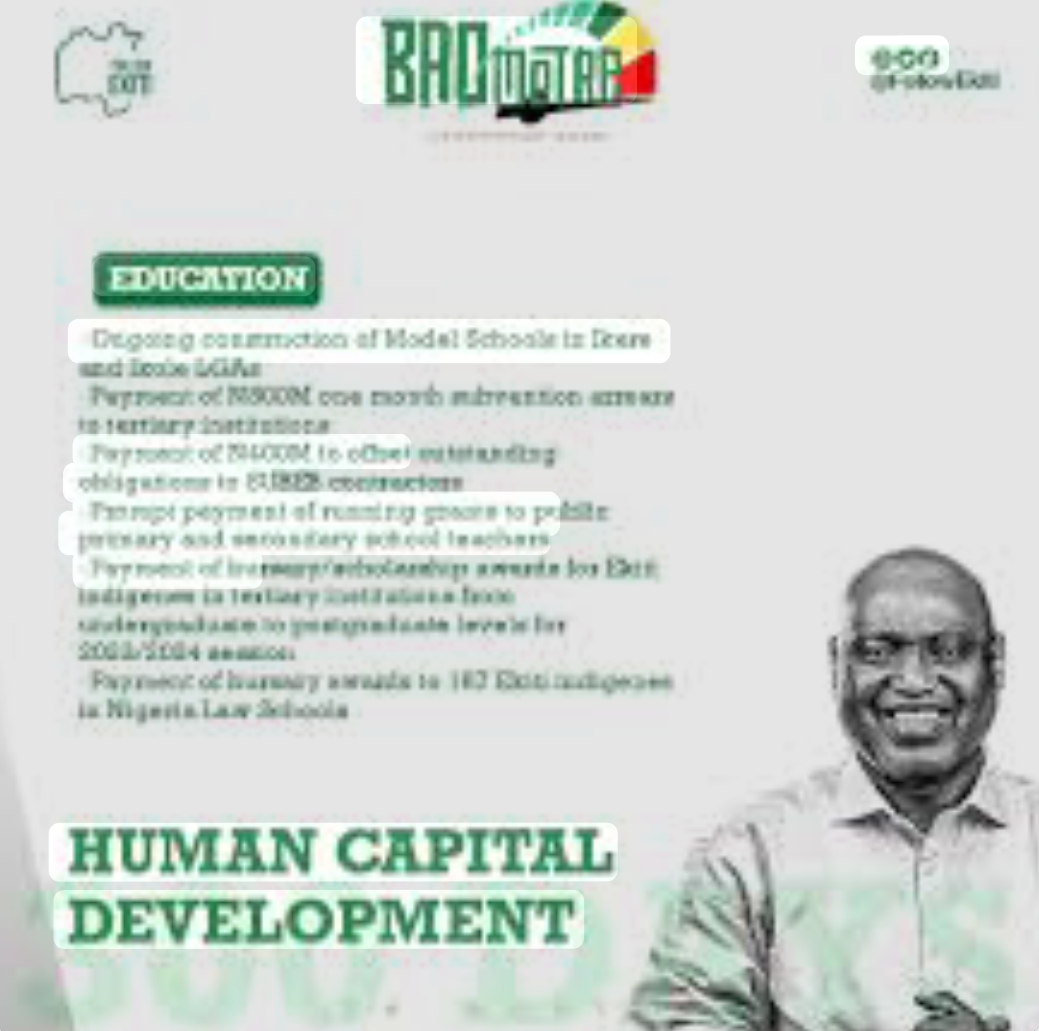
HUMAN CAPITAL DEVELOPMENT: WHAT GOV. OYEBANJI HAS DONE TO DATE
By Segun Dipe
If infrastructure is the body of a state, human capital is its brain. Governor Biodun Abayomi Oyebanji, BAO, understands this. That is why “Human Capital Development” is Pillar 2 of his 6-pillar Shared Prosperity Agenda. In just over three years, BAO has moved Ekiti from a “Fountain of Knowledge with decaying schools” to a “Fountain of Skills, Health and Digital Talent”. His focus is simple: fix the learning environment, pay teachers well, equip young people, and leave no one behind.
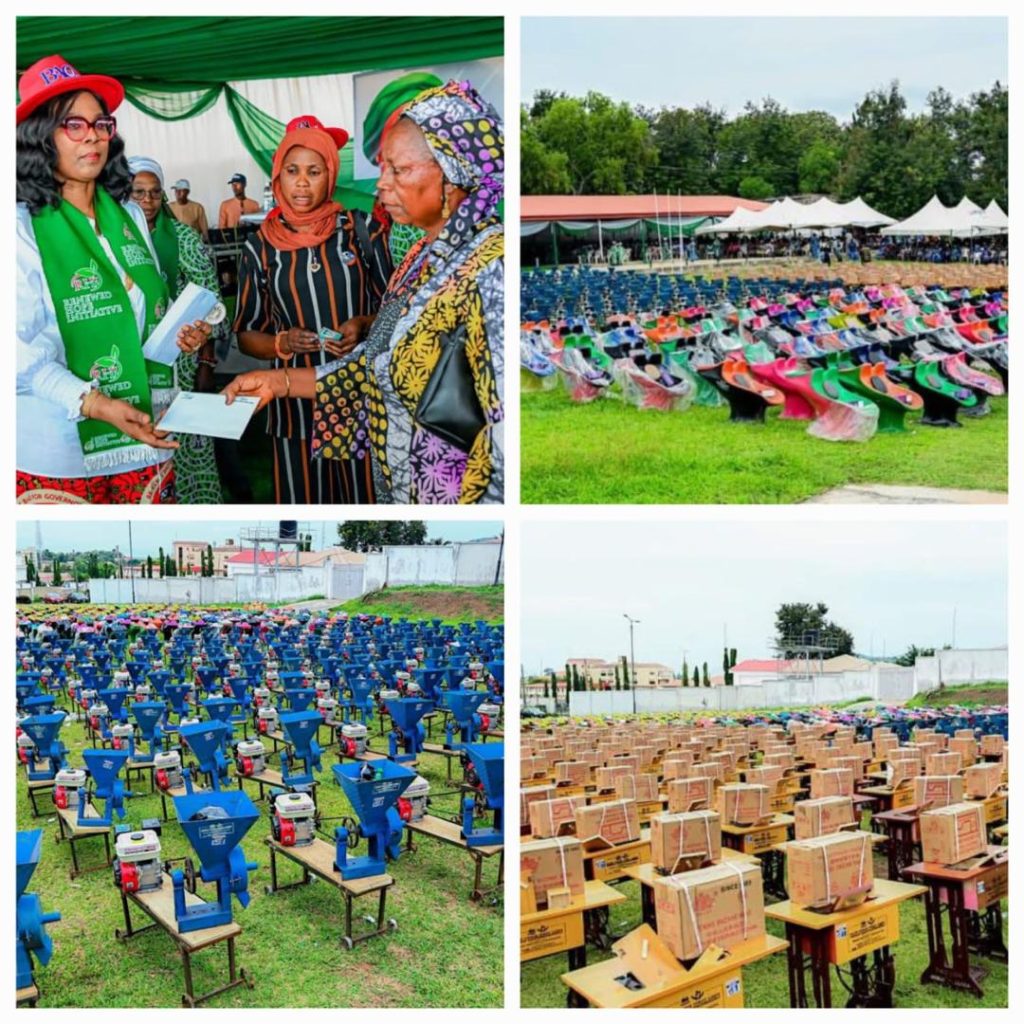
The six-pillar agenda of Gov. Oyebanji was designed to provide the right answers… and the administration can lay claim to human capital development through free, qualitative and compulsory education, as well as healthcare that is available and accessible.
Revamping Education, One School at a Time
BAO’s administration is rebuilding Ekiti classrooms brick by brick and laptop by laptop.
Under the World Bank AGILE programme worth ₦14.2 billion, no fewer than 200 public secondary schools are undergoing massive renovation and rehabilitation. 1,415 classrooms have been renovated and 83 new ones constructed to end overcrowding. For school hygiene, over 400 modern gender-friendly toilets were built and 277 renovated. 32 boreholes were sunk while 8 were rehabilitated. For security, 48 schools were fenced and CCTV/security gadgets installed.
To improve learning, 18 libraries were renovated and furnished, 69 science laboratories upgraded, and 67 multipurpose halls provided. Special schools were also prioritized, with ₦165 million approved for Government Special School, Ido-Ekiti and School for the Deaf, Ikoro-Ekiti. An additional ₦28 million from BAO’s birthday donations was used to upgrade beds, solar power and freezers in special schools.
To drive digital learning and uninterrupted power, 2,716 laptops and 1,470 desktops were distributed to schools, smart boards installed in all 203 public secondary schools, internet provided in 125 schools, and 5KVA inverters installed in all 203 schools. A 250-capacity ICT centre was also commissioned at the College of Nursing, EKSUTH for digital health training.
To equip students with critical thinking, creativity and 21st-century skills, government partnered with KOICA, South Korea on the Smart School Project.
Teachers and Access
Within the first 200 days, no fewer than 1,300 primary school teachers were recruited. To unlock more school rehabilitation, the ₦1.2 billion UBEC counterpart fund was paid. WAEC/SSCE fees worth ₦546.9 million were paid for 16,269 SS3 students in public schools, including students with disabilities.
On welfare, car and housing loans were increased by 100%. Cash awards went to 138 civil servants. Graduate primary school teachers were elevated to GL 16, while science teachers’ allowance is under review. ICT training for teachers was also provided in partnership with HP/Azzess World Technology to make them 21st-century compliant.
In the words of the governor: “Education is the bedrock of our future… We are not just renovating buildings, we are reshaping destinies.”
Health: A Productive Population
BAO believes a healthy population is a productive population. Upon assumption, he renovated 11 general hospitals, followed by the renovation and equipment of 9 more general hospitals and 105 primary health centres. An 80-bed multipurpose medical building is also under construction at EKSUTH, Ado-Ekiti.
Today, every Ekiti resident enjoys a guaranteed package of essential services free at the point of care. The results are clear: NDHS data shows neonatal, infant and under-5 mortality dropped by over 50% in five years; teenage pregnancy is down 30%; facility deliveries are up 14%. Free healthcare is also provided for Persons With Disabilities at all primary health centres.
Skills and the Digital Economy
Government is training young people for jobs that pay. Through the Ekiti Digital Acceleration Programme, 1,000 youths aged 15–20 are being trained in ICT. The first batch has already received free laptops to start earning. The programme focuses on cybersecurity, software development, AI and data analytics. Ahead of the Ekiti Knowledge Zone, 2,000 youths have been facilitated for advanced digital skills training in the same areas.
The Adire Ekiti Hub has trained no fewer than 600 youths and widows in tie-dye in partnership with the Nike Okundaye Foundation, with 200 participants drawn from each senatorial district to ensure equity.
Other youth-focused efforts include the NADDC mechatronics training, where technicians are trained and equipped for CNG/petrol tricycle and motorcycle repairs — described as “lifelines for families”. Through the World Bank’s Innovation Development & Effectiveness in Acquisition of Skills programme, technical colleges at Igbara Odo, Ijero and Otun Ekiti are being upgraded with modern equipment for skills acquisition.
To give youth a voice in governance, the Ekiti Youth Parliament was strengthened with leadership training.
BAO’s human capital agenda is deliberately inclusive. 120 Persons With Disabilities were trained at the Skills Acquisition Centre, Ado-Ekiti and given start-up kits, cash support and Trade Test certificates under a ₦100 million programme. 28 of them were employed into the civil service, while free education from primary to secondary and free assessment/therapeutic services were introduced for them. Special education infrastructure has also been upgraded with beds, solar power, water reticulation and dormitory bathrooms at Ido, Ikere and Ikoro special schools.
Financial Empowerment
For leather shoemakers, broiler producers and beekeepers, government partnered with WEMA Bank to train 100,000 youths and students in MSMEs.
Through SUBEB and the Ministry of Education, government has upgraded infrastructure, recalibrated the curriculum for 21st-century needs, and ensured teacher welfare is prioritized.
Bottom Line
Through deliberate manpower development, BAO has invested heavily in the “software” of Ekiti. While roads and the airport are visible, the laptops in young hands, renovated labs, paid WAEC fees, and trained PWDs are the real game-changers. The governor is building a generation that can compete globally without leaving Ekiti.
Segun Dipe is the PRO of APC in Ekiti and Co-Director of Media and Communications, BAO 2026 Campaign Directorate.